
Couldn't sleep last night. So I got up at 4:00a.m. and did some math. It's about Noro Silk Garden.
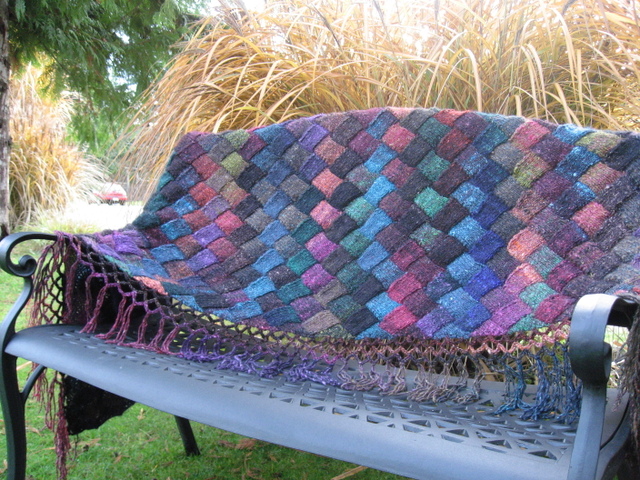
Problem: If one knitter, myself, knit eleven projects out of said yarn, 42 skeins of conventional Silk Garden and eight of Silk Garden Sock yarn, how many silken gardeny miles were knit?
Answer: 4.1 miles or 6.6 kilometers = 7217 yards or 6600 meters.
And I have 26 skeins left in my stash. We're not going to do a cost analysis because most were bought on sale or on ebay, but still, it's frightening to even think about it.
Now, with all this Noro experience, I thought I'd write a review of sorts. The pros and cons of Noro Silk Garden:
Pros:
- A multitude of colours – it's like knitting with a rainbow. Particularly beautiful for entrelac, diagonal designs and modular techniques. Just look at that photo above. Remember my first oversized Lady Eleanor AKA my office blankie? Those colours make my knitting glands salivate. Here's another one. And another, in the same colours.
- Can often be found on sale.
- It scores high on the drape factor.
Cons:
- Knots – up to four per skein. I hear that that's the acceptable limit according to their quality control standards. However, along with the knots come abrupt colour changes sometimes necessitating adjustments to the order of colours being used, requiring the joining of a different skein and leaving more ends to weave that anticipated.
- Detritus – straw, twigs, bits of fluff.
- Disintegrating yarn – occasional sections of unspun fluff that pulls apart with the tiniest of tugs.
- Thick and thin qualities – most people really hate this, but I don't mind the varied texture it produces.
- The finer the yarn, the rougher the feel. Regular Silk Garden is softer than the sock yarn. It does soften with age and washing.
I look at these lists and wonder why anyone would bother to knit with it. What can I say? Its beauty trumps its shortcomings. And writing this was an alternative to counting sheep. Good night.


 Life's a Stitch
Leave a reply to Rebekah Cancel reply