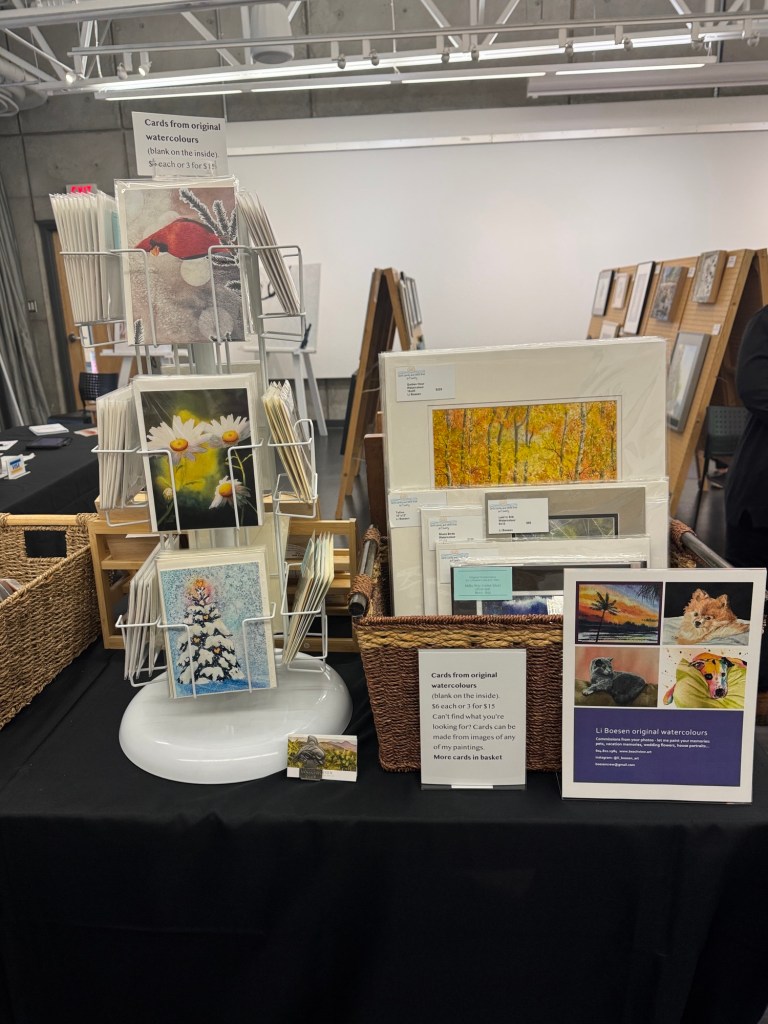
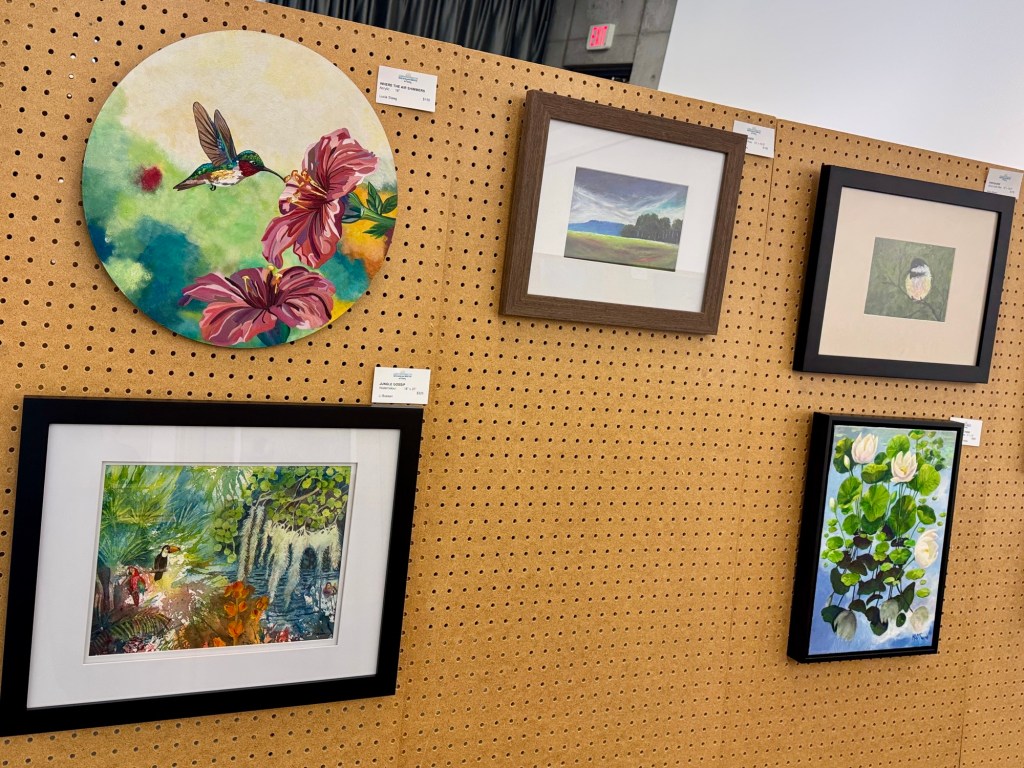
It’s hard to believe that this was the eighth South Surrey/White Rock Fall Art Show since we’ve moved to the area. I’ve participated in three or four.
It’s a fair amount of work. You’re allowed to exhibit up to three framed paintings, a basket of smaller paintings and a selection of art cards. A two hour volunteer shift is required, but that’s fun part, working with other artists and meeting people interested in your art.
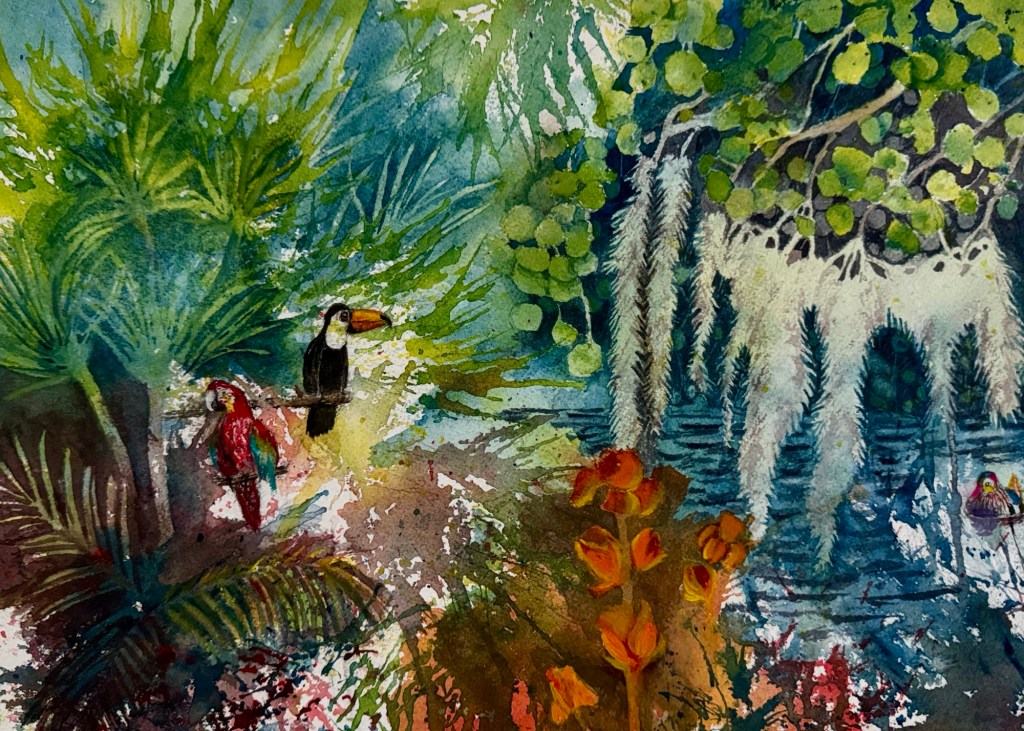
I was pleased that my “Jungle Gossip” painting found a happy home.
One framed painting and 35 cards sold made it a successful show for me.
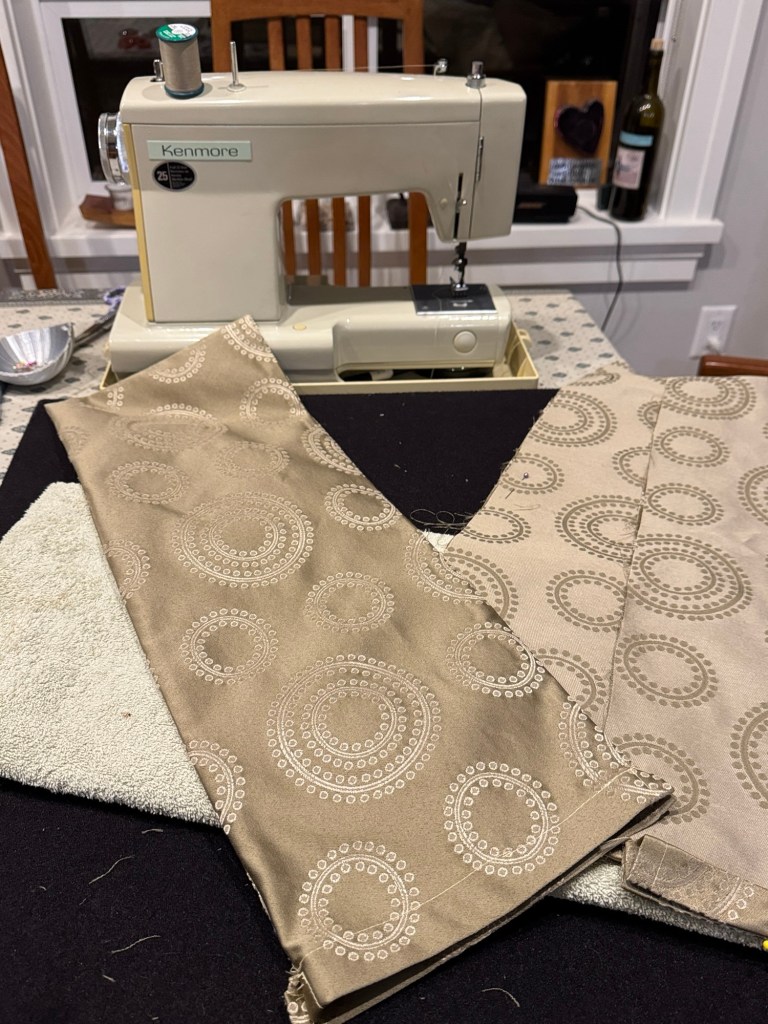
Fifty years ago I bought my second sewing machine. My first was an inexpensive budget model Brother bought at Woolco. Within a year I graduated to a midrange Kenmore that has faithfully served as my reliable workhorse. I think it cost $150. It’s well made with metal parts; only the plastic end piece and carry case are discoloured with age. A friend who repairs sewing machines confirms it’s a keeper and should last another 50 years. Mari was able to find its lightly used sibling in Calgary for $25.
It sounds like I spend a fair amount of time sewing. Nope. I have no business undertaking anything that involves a pattern. Hemming, minor repairs and alterations, fine. But I’m famous for spending 12 hours on a Simplicity Two Hour pattern, omitting the decorative buttonholes. Truth be told I don’t think I’ve ever sewn a buttonhole.
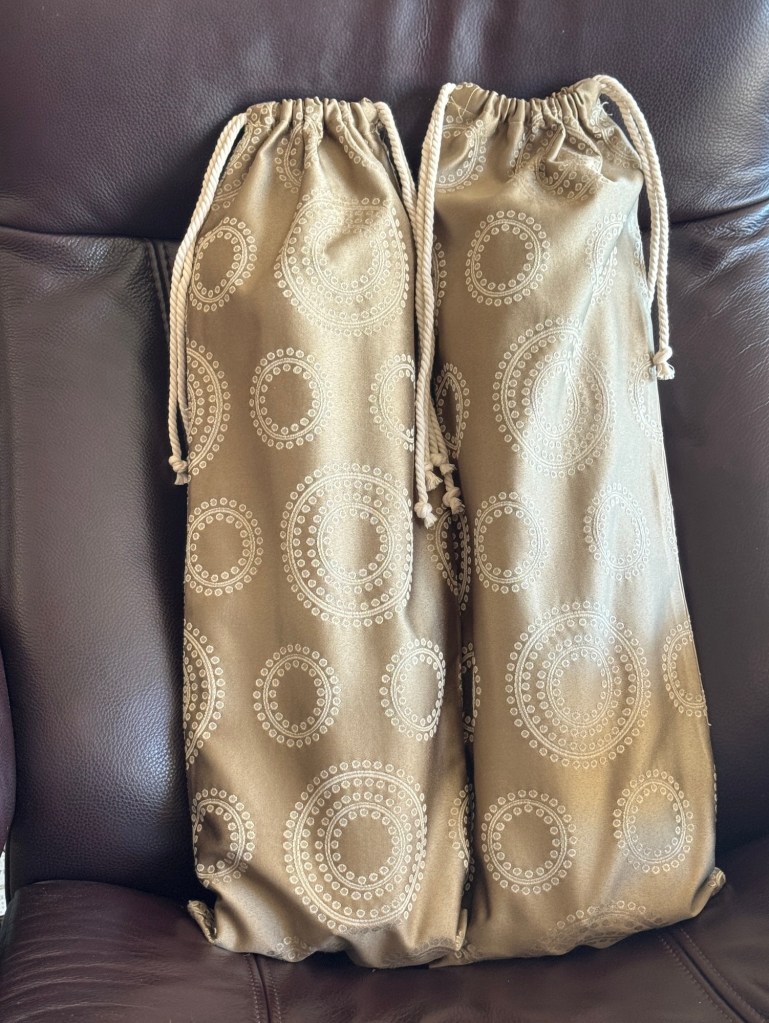
This time the project was three sets of storage bags for mahjong racks and mats. The pattern was a ten minute drawstring bag. The fabric was surprisingly nice, being a bulk piece from Walmart. The YouTube instructor I watched said to ignore the pattern name, it would actually take 30 minutes. For me, make that well over an hour. The ironing alone, for six French seamed heavy fabric bags took a total of an hour and a half. I think it was worth the effort.
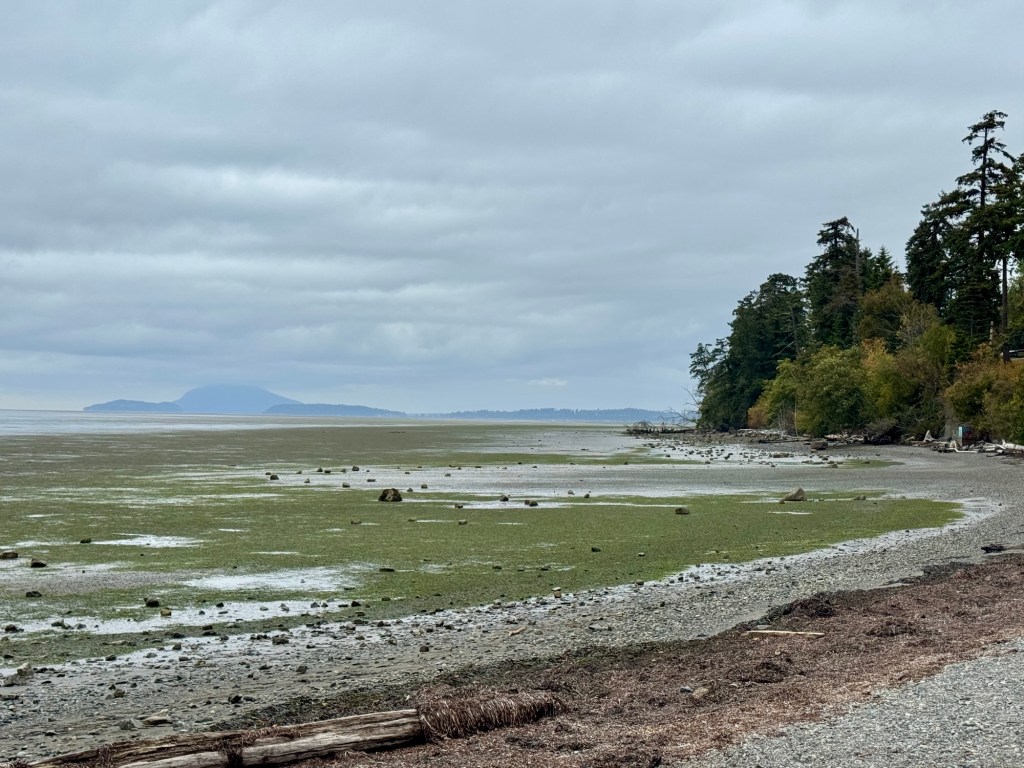
We’re on our last camping trip of the year, to the same location as last year’s final one with the same friends. Does that constitute a tradition?
A search tells me the first time is an event or one time choice. The second, a deliberate repeat that establishes a tradition. The third cements it into a routine.
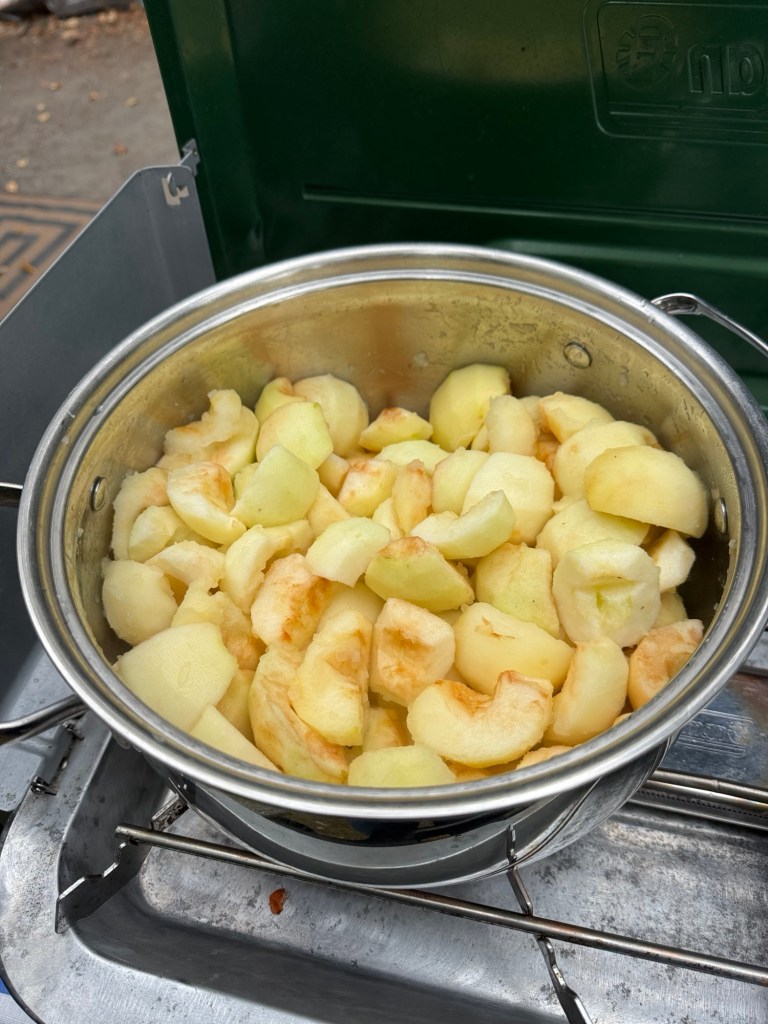
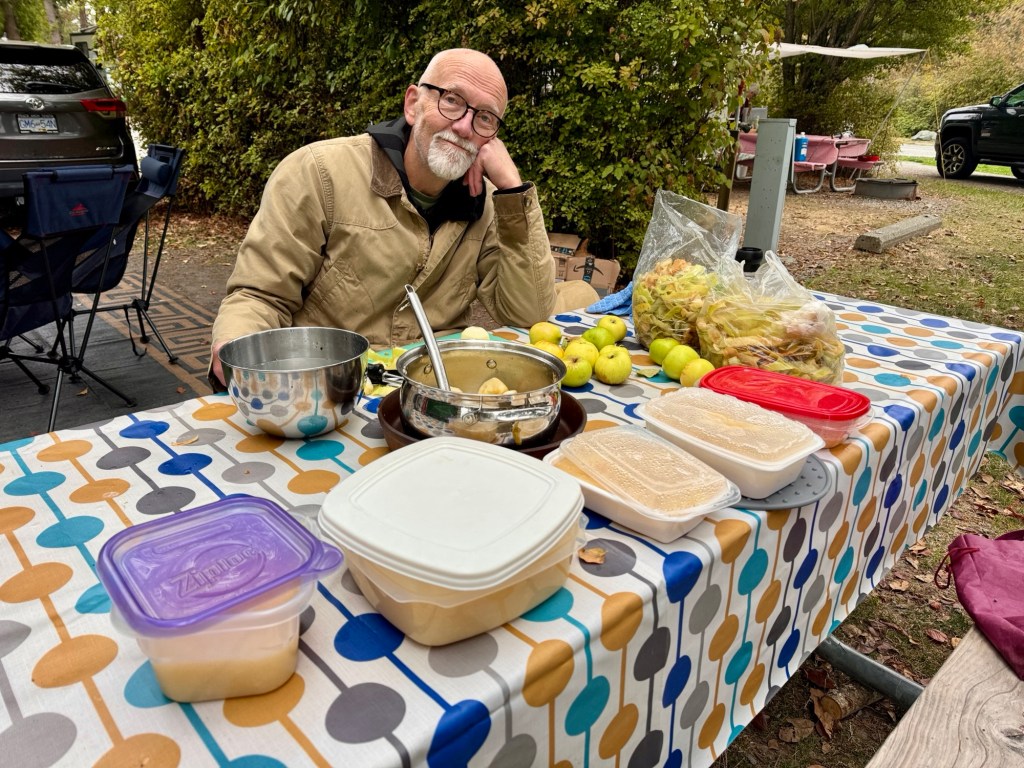
The tradition I like most about this annual trip is picking apples and making campsite applesauce.
The location is not without its hazards. Last year while geocaching I disturbed a hornets nest resulting in multiple stings and a round of steroids. Two days ago I slipped on hard windfall apples, the equivalent of giant marbles, dislocating both my knee and right thumb. Fortunately I know my joint issues and both successfully popped back into place, but I have the bruises as a souvenir.
This year C was a most enthusiastic picker, not listening three times when I said I thought we had enough apples. As my thumb is out of commission, he had the honour of peeling and coring his enthusiasm.
Next year he might pay attention, but in the meantime we have seven quarts of deliciousness to enjoy.
The days have been cool and grey, turning into Pacific Northwest autumn mizzle.
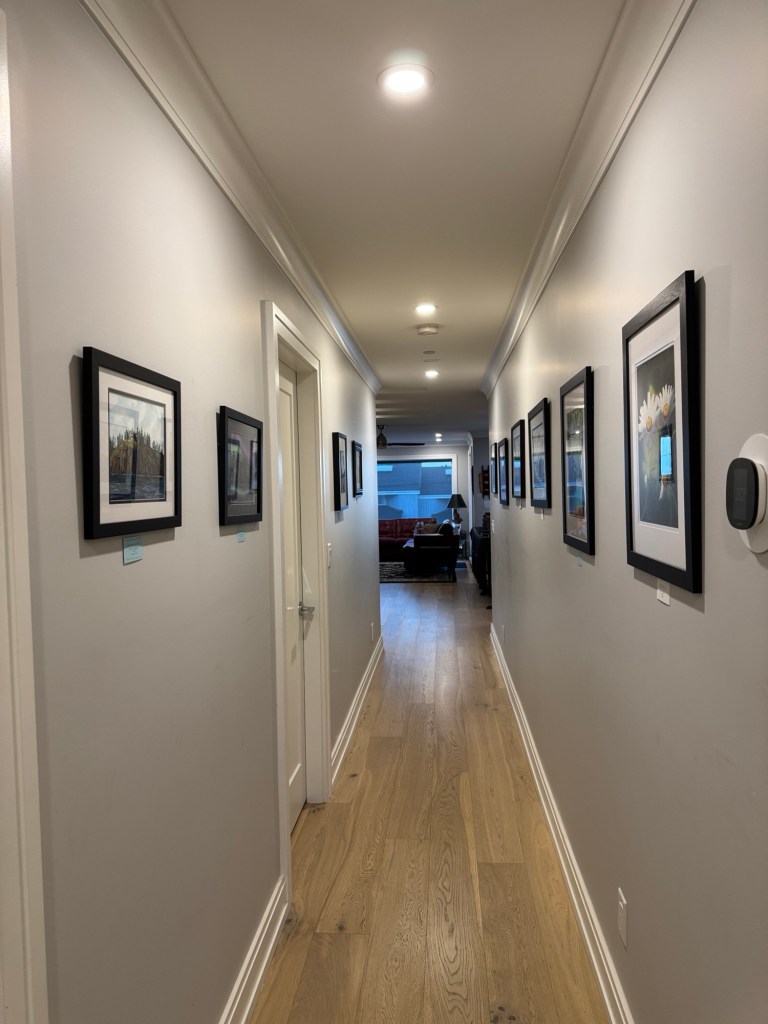
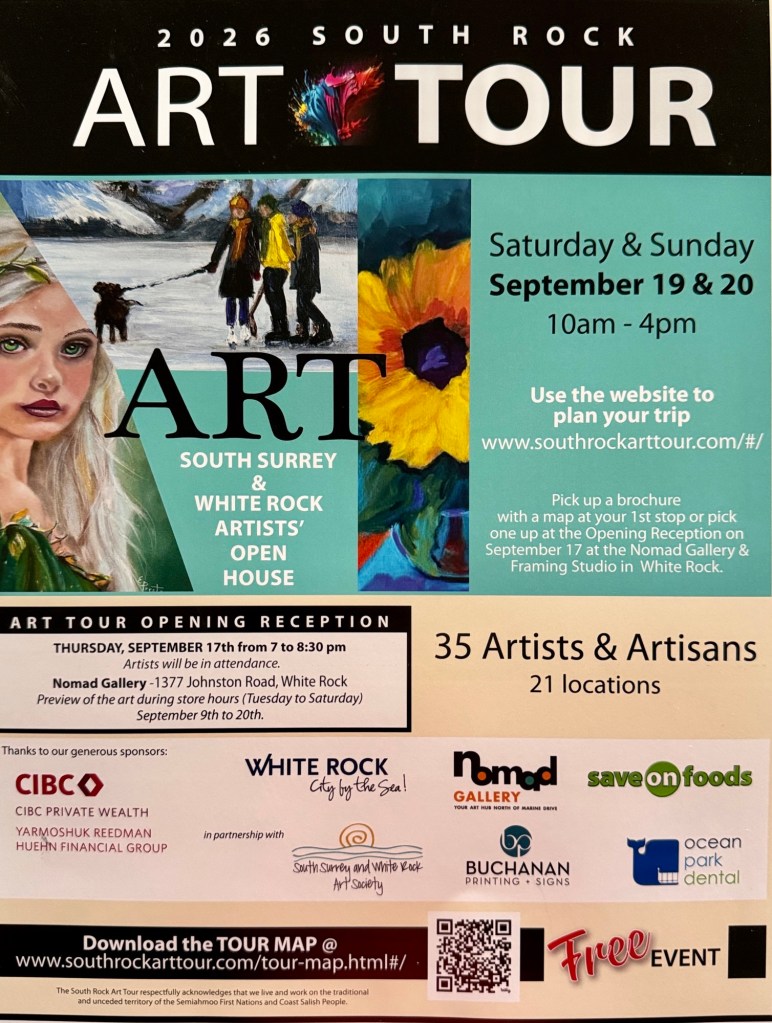
The house is set up for our participation in the South Rock Art Walk. We are two of 35 participating artists. The calm classical music is playing and we are enjoying the quiet before things get going.
Schubert’s Ave Maria is playing and it brings to mind a scene neither of us can erase from our minds. Sitting in the church at the First Communion of our two daughters, one of the school’s teachers, a professional singer, was performing. Then from behind us a man starts whistling along. We can’t hear that piece without whistling.
Funny how music can bring back strong recollections, supposedly like the sense of smell that attaches itself to vivid memories. Another one is whenever I halve a banana it automatically transports me in time to when we were renovating our house on Canyon Blvd. Musically inclined Bryant, age 7, connected with the drywaller, who also a worked as a vocalist and musician. He presented B with one of his CD’s that included a song with the lyrics “Half a banana, na, na, na, na, na, na, na.” I had actually forgotten that until B reminded me this past year. 🙄 I can’t cut a banana without singing that song.
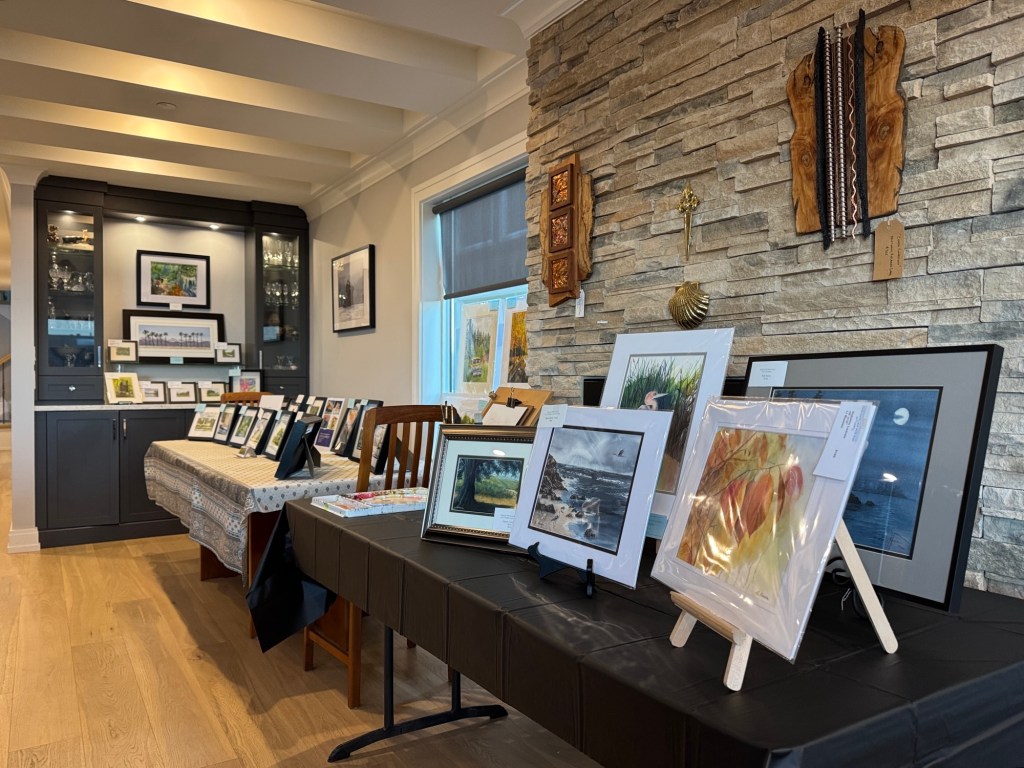
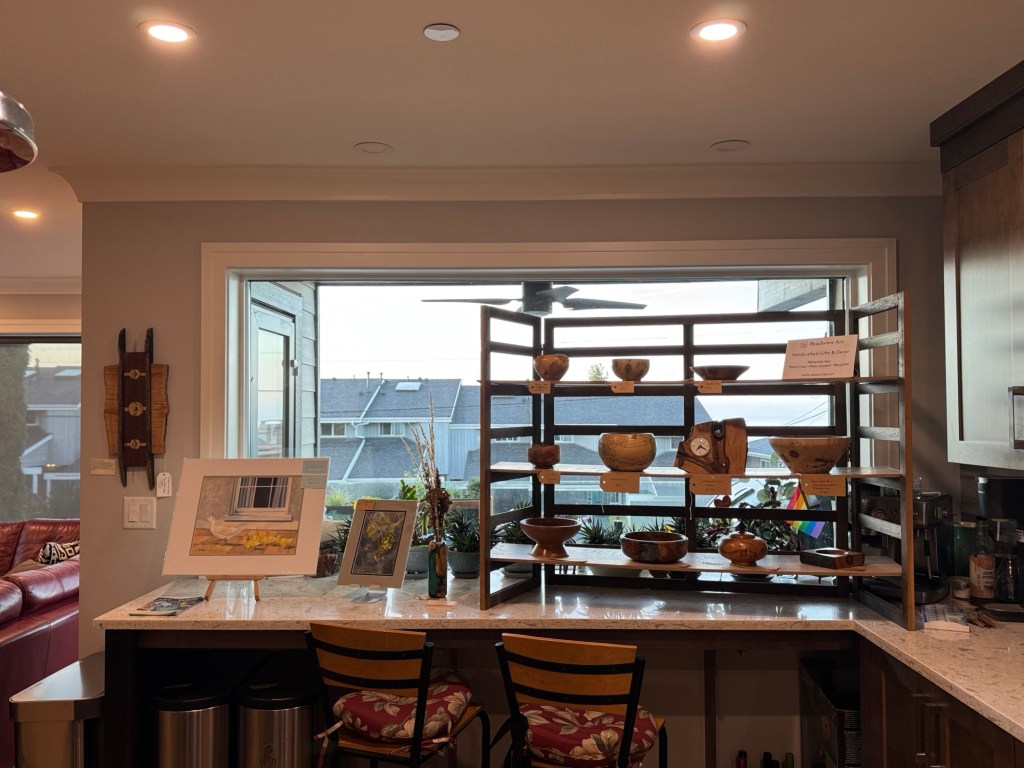
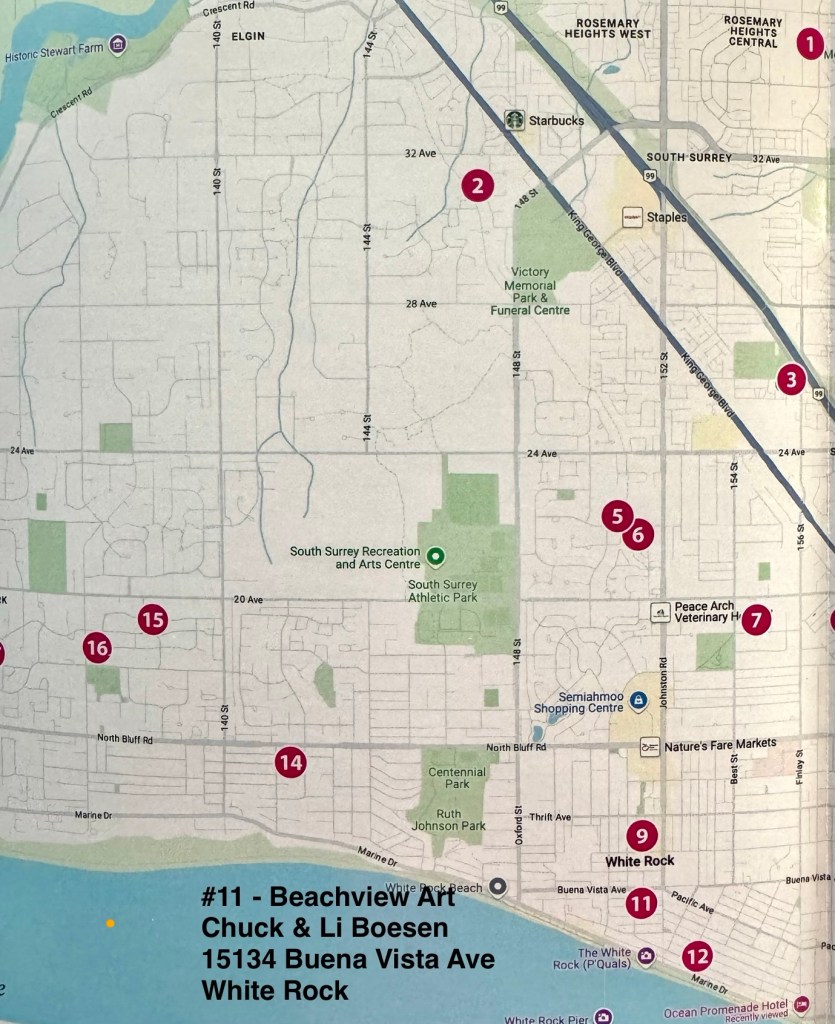
Chuck and I will again be displaying watercolour and wood art from our home during this year’s South Rock Art Tour, Sept 19 and 20, address on map. Hope to see you here.
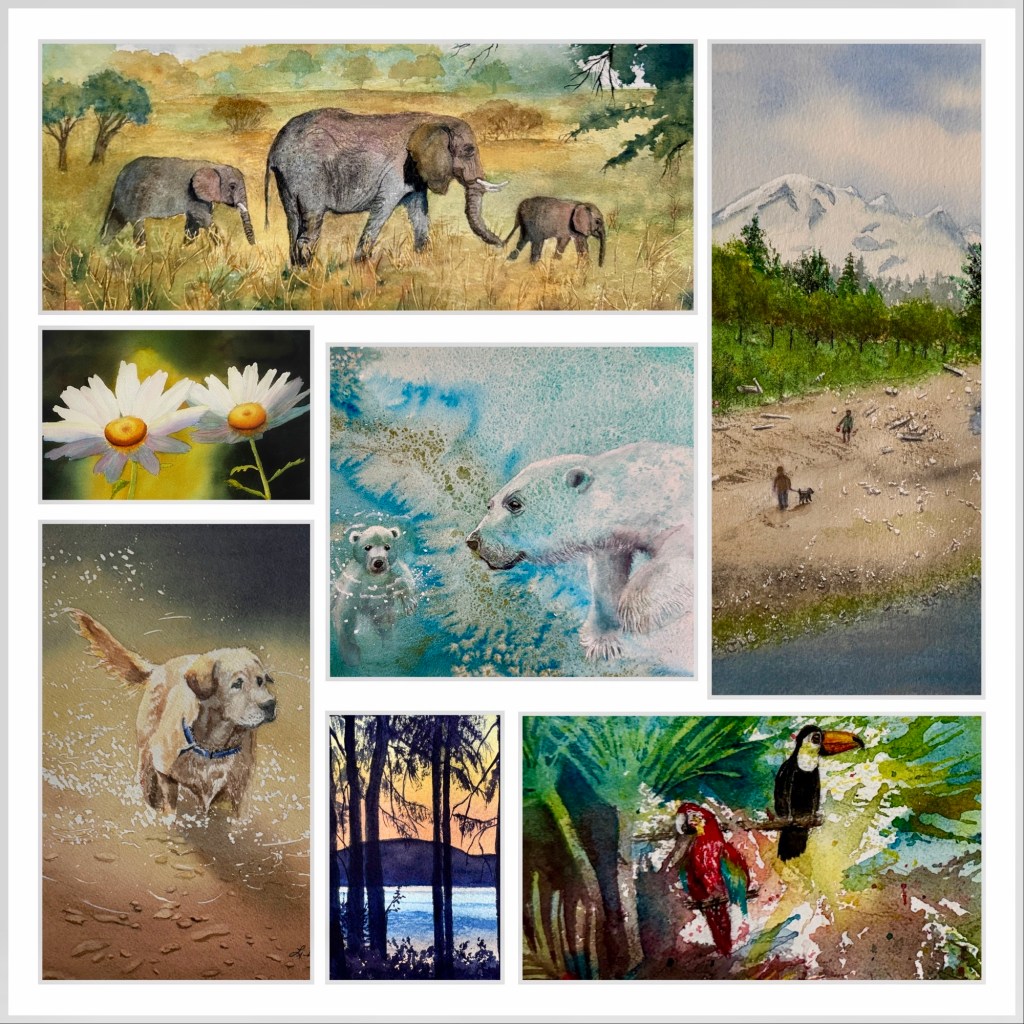
Samples of seven new 5×7 art cards in my collection, $6 each or 3 for $15.
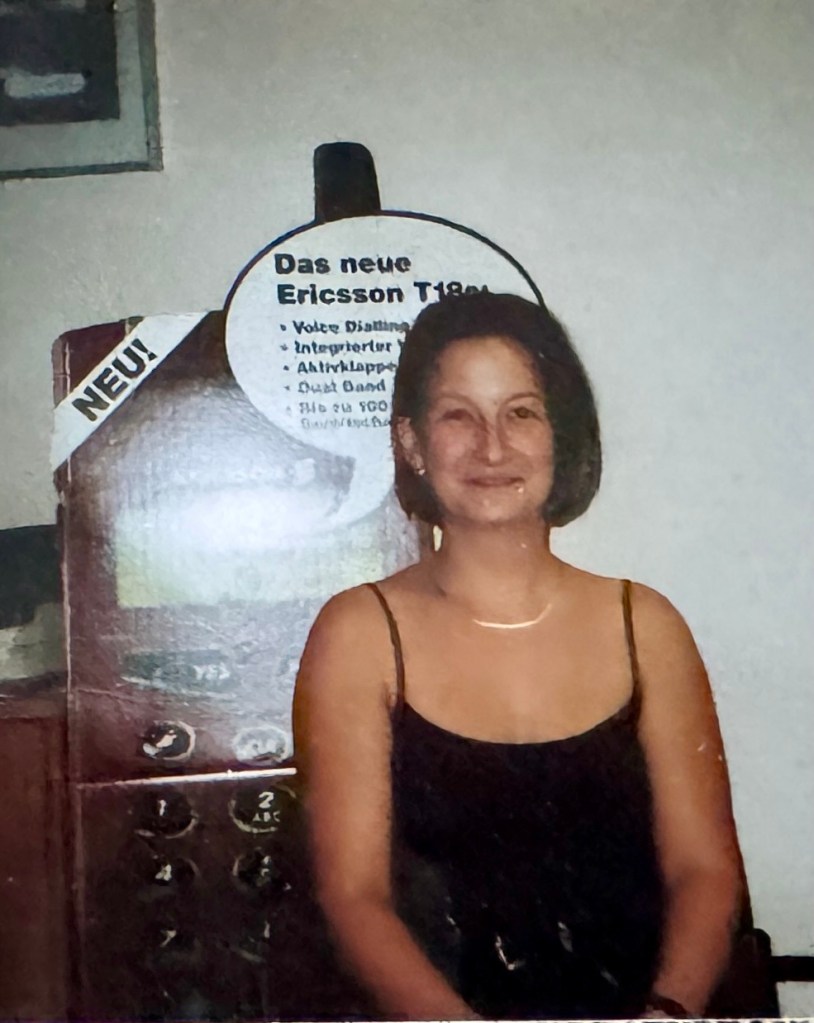
This is a picture of Janett 23 years ago, prior to her arrival in North Vancouver as our homestay student.
This is Janett now. So happy!
Twenty three years ago Bryant was 12 years old, about her daughter Emma’s age. Emma pointed out that Janett has known our family longer than she has known her own immediate family. We have history.
So much fun. While they visited we watched BC Day fireworks from our deck.
There was a daytime show in the sky, the Canadian snowbirds performing one off their last shows prior to going on hiatus as they wait three years for the construction of new planes.
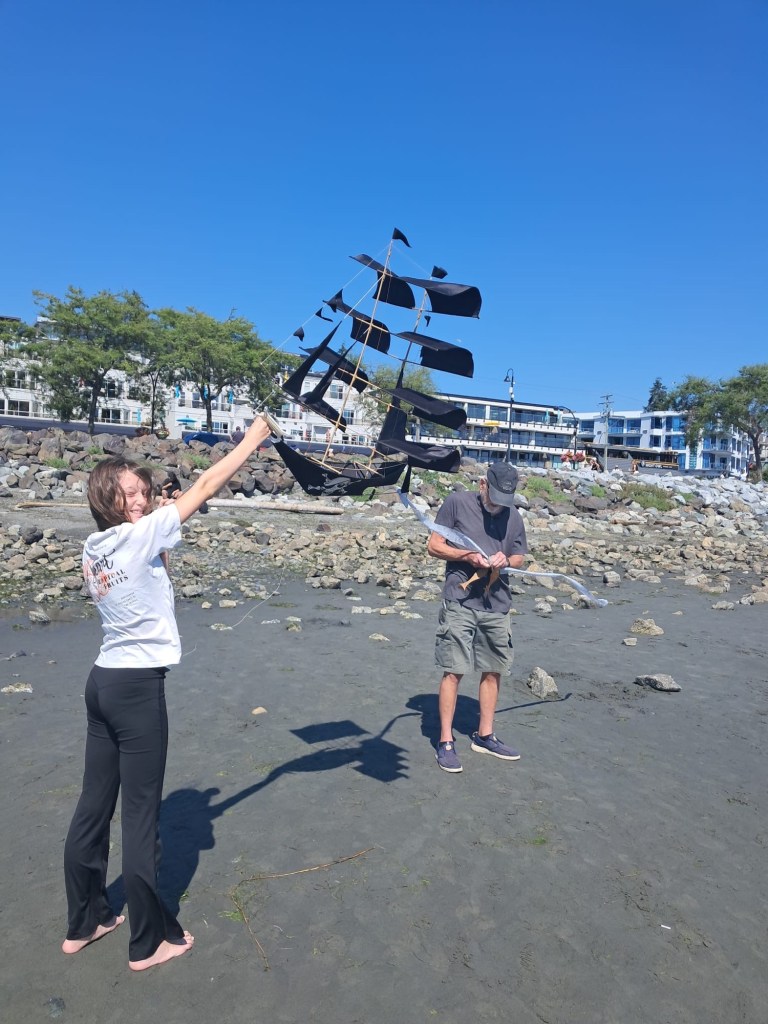
A flying object on the beach didn’t fare so well. We bought the pirate ship kite in Bali. Over the years it suffered seemingly irreparable damage and as C was headed to the trash bin a man stopped him. He explained he used to have a similar kite from Bali and would be willing to give this one the tlc it needed to try and fly it again. Done. I hope we see it fulfilling its purpose in the future.
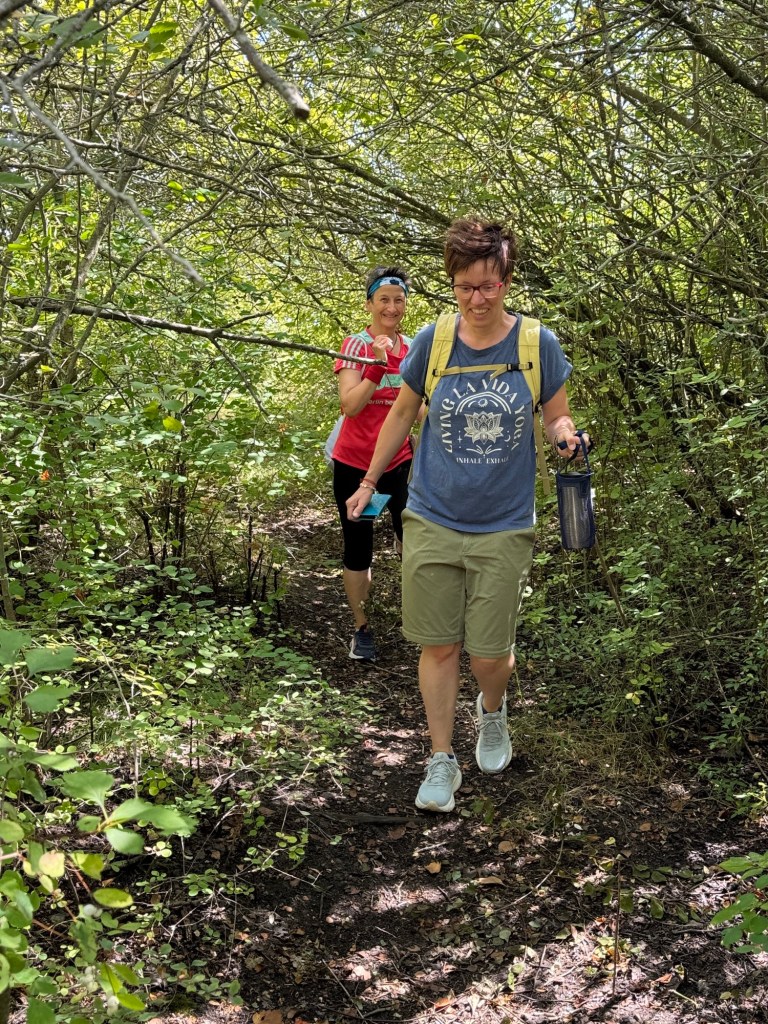
We drove the 12 minutes to Crescent Beach for a loop walk on a beautiful day.
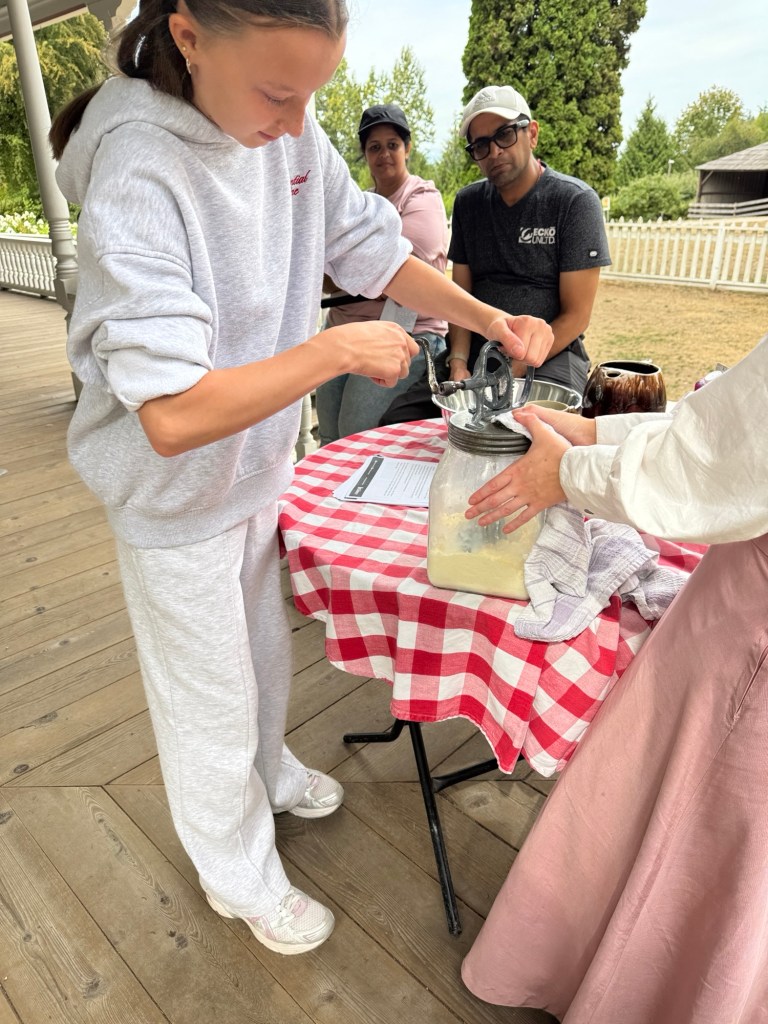
We churned butter at the historic Stewart Farm.
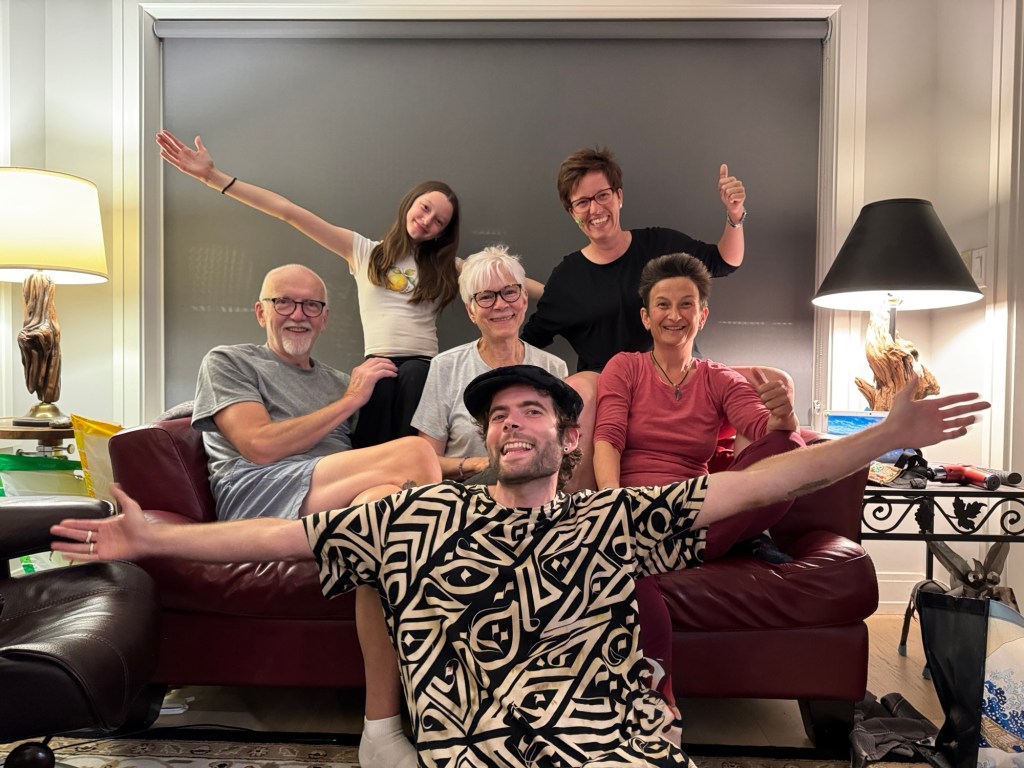
When the two weeks came to a close it was time for the official group shot.
Living on the BC coast of Canada it’s easy to attract summer company. When I lived in Omaha NE, not so much. The past five weeks have been a whirlwind.
You’ve read about the first two with Mari, KC, Bella dog and puppy Luigi, whose energy in particular I miss.
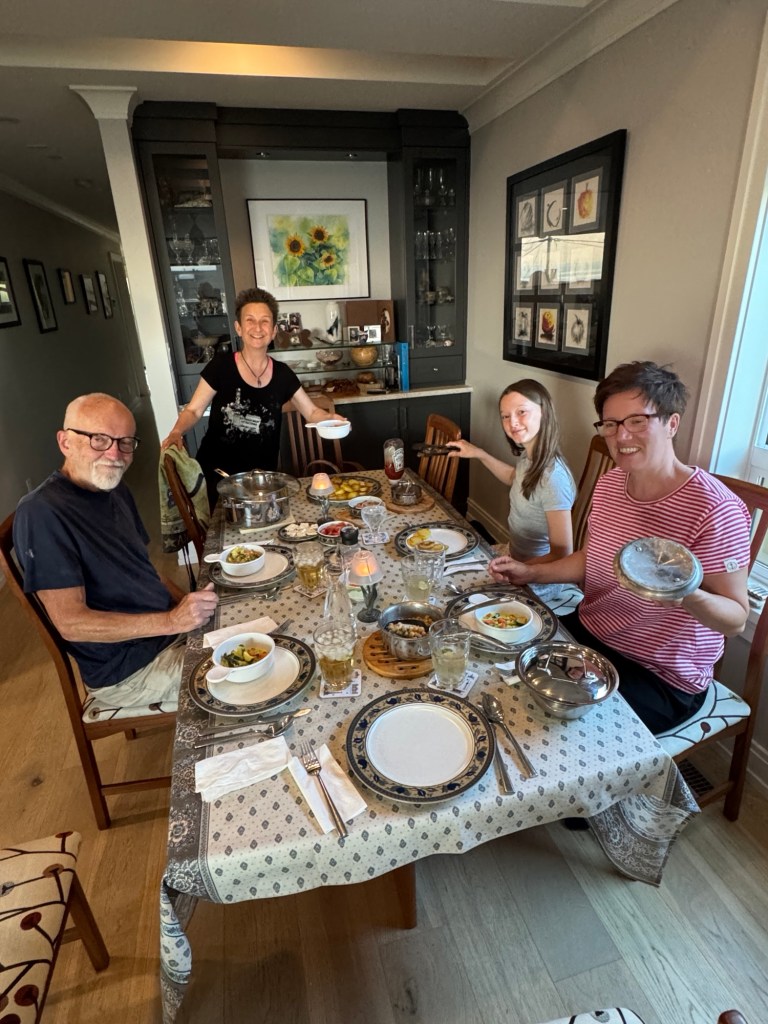
Shortly thereafter, Bryant arrived with Justus, a friend from Berlin. They overlapped with former homestay student, Janett (who joined our family 23 years ago) accompanied by her wife, Anne and their daughter, Emma (age 11), all also from Berlin. Emma did a good job filling in the missing sweet Luigi energy.
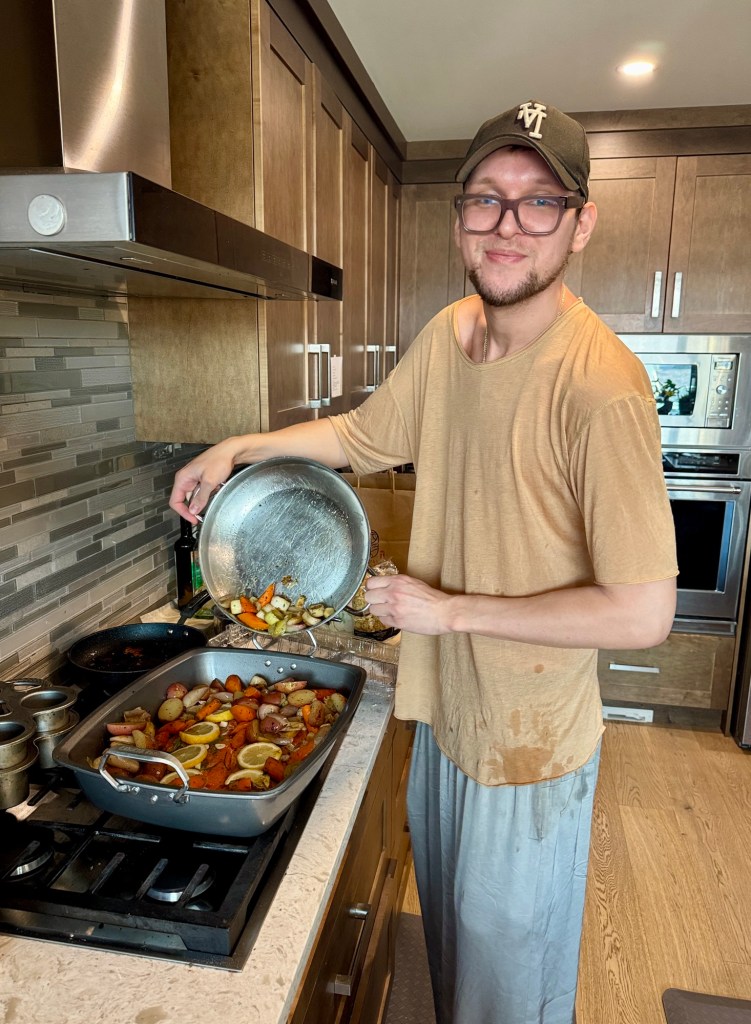
This post will focus on the food, which was spectacular. Justus treated us to his mother’s one pan salmon recipe that required a giant cooking vessel. Always wanting a handled roasting pan, I found this recently, new in box at the Salvation Army.
My other purchase that day was a new kabob attachment for our gas grill:
Other special meals were vegetarian by Janett and Anne
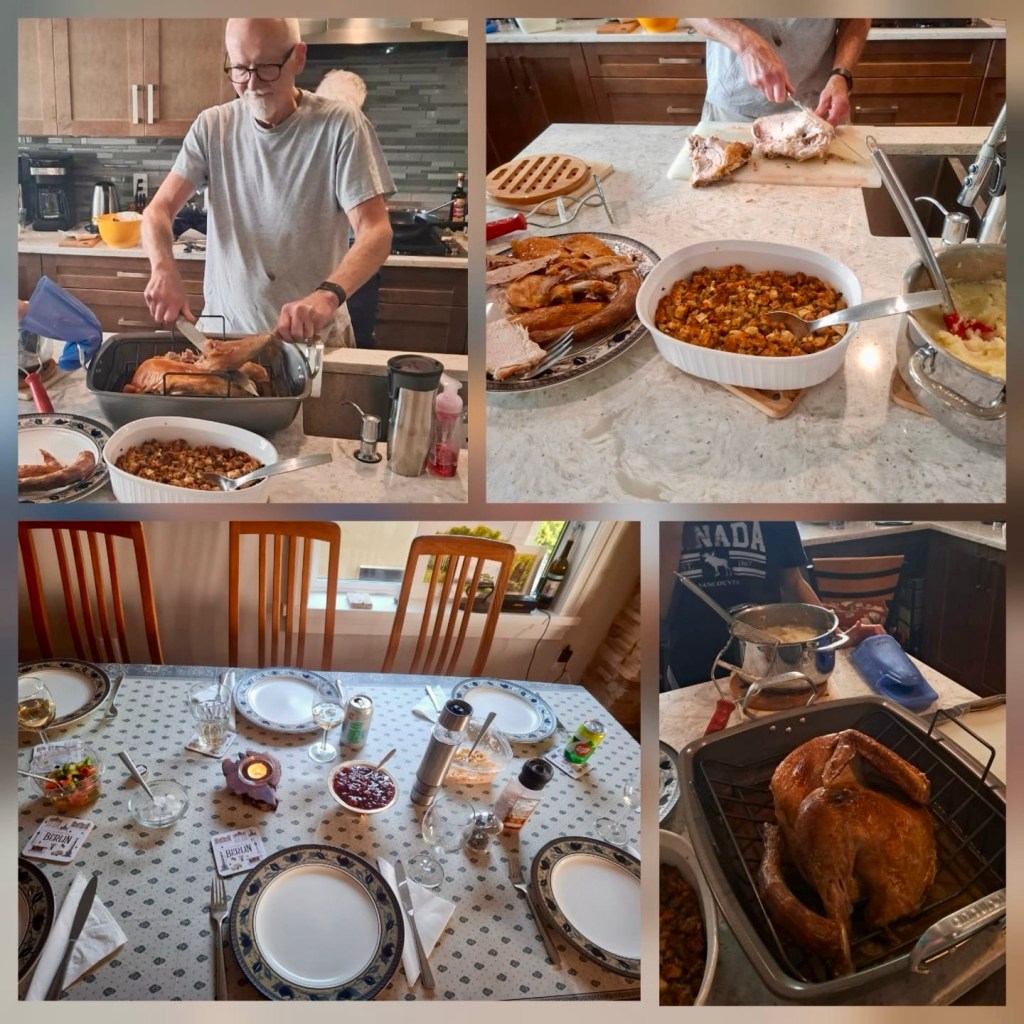
and Thanksgiving in August when I discovered they had never had turkey:
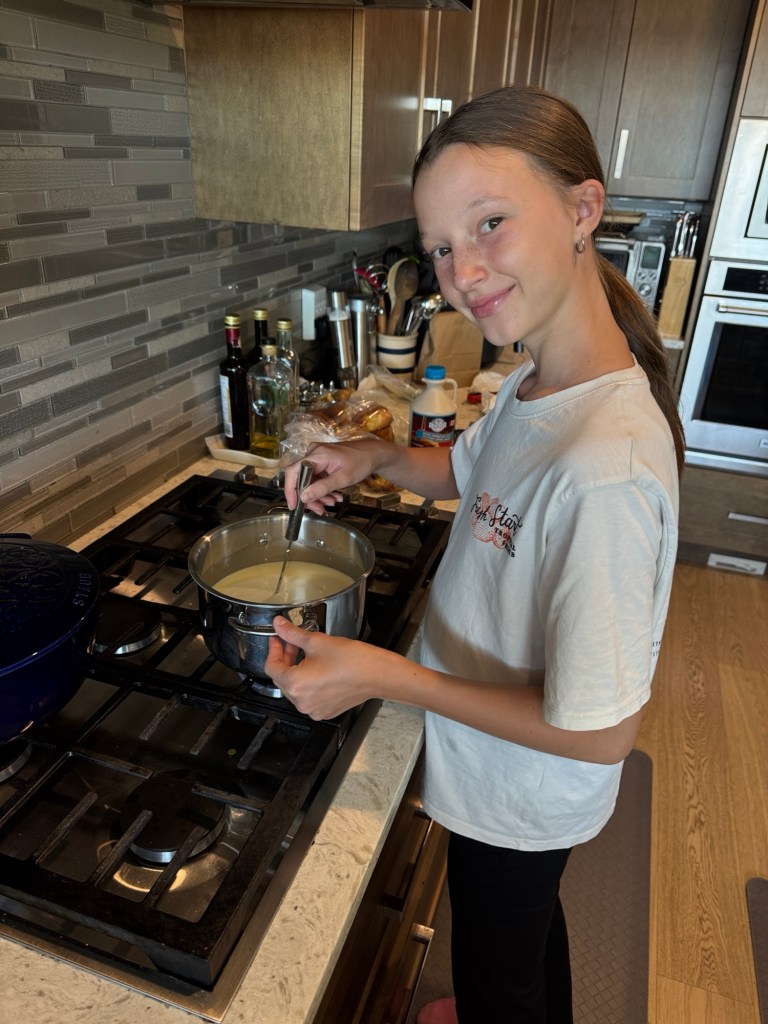
Emma and I made homemade ice cream
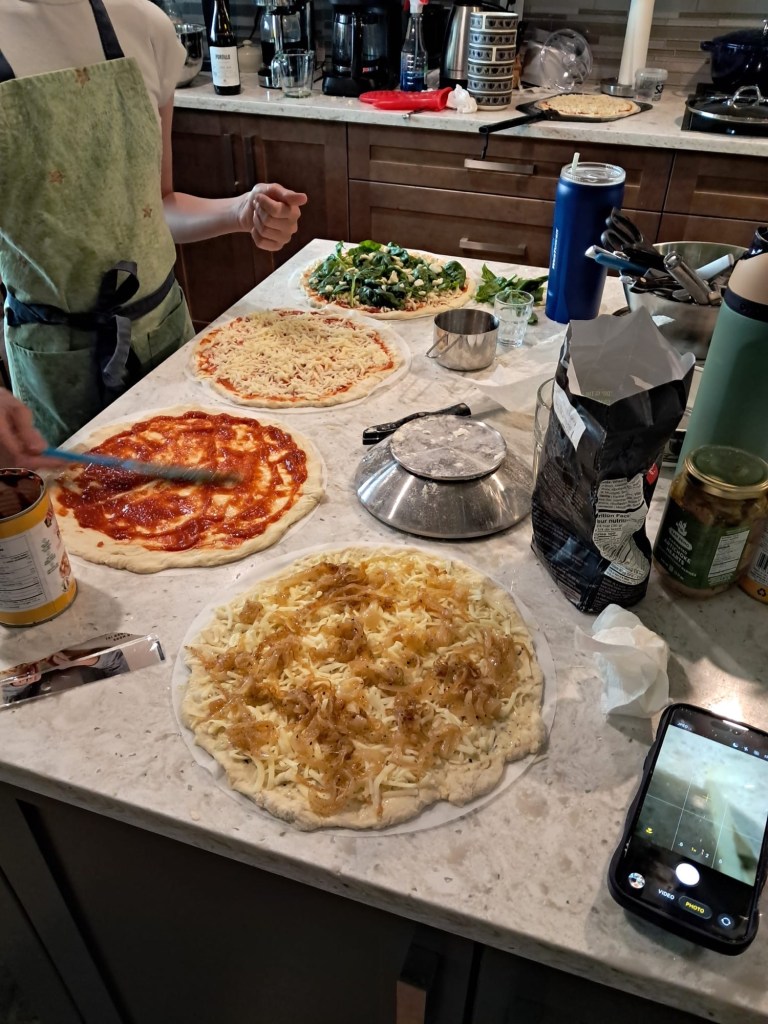
And pizza:
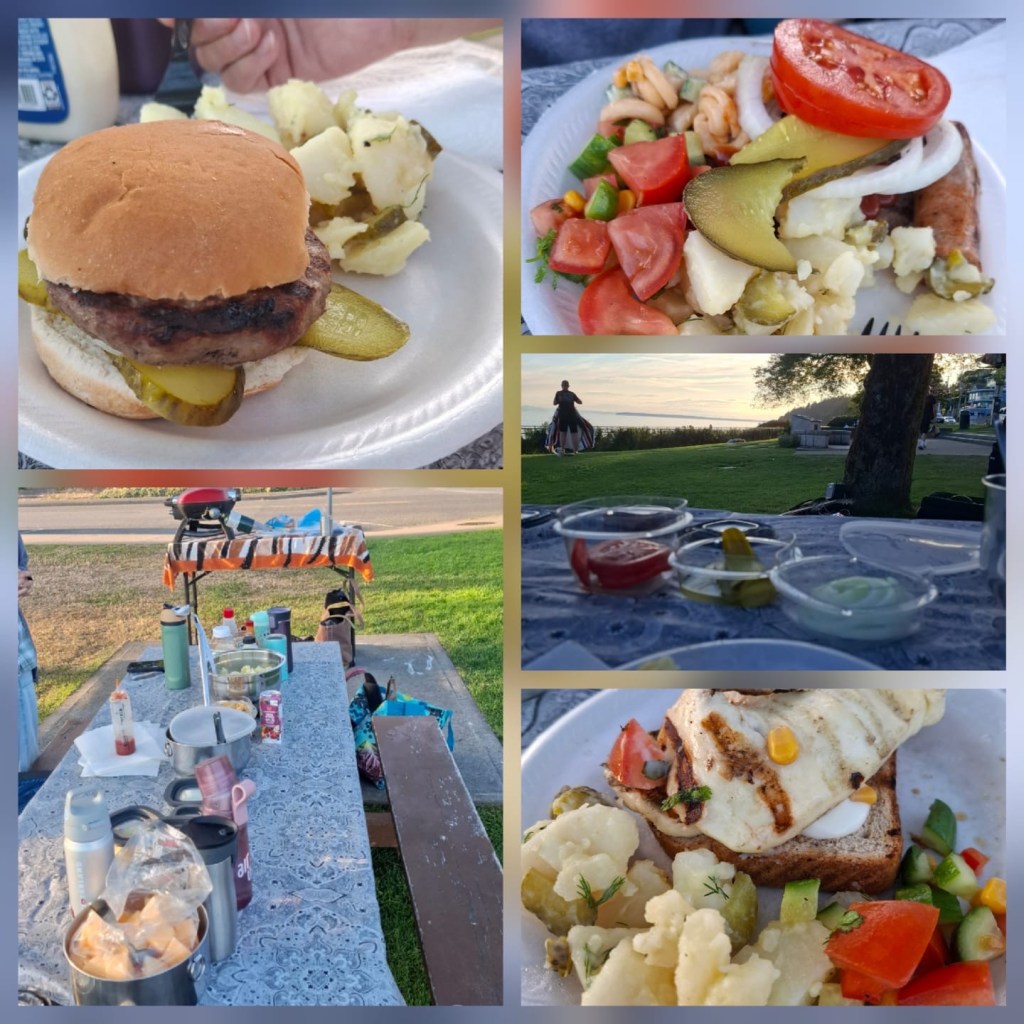
The weather cooperated for a barbecue on the beach, which included Anne’s German potato salad, a recipe I’ve used many times over the years and shared with others.
The house was alive with happy voices and live music. Dinners expanded with the addition local friends. We did more than eat. Stay tuned…
In anticipation of a houseful of guests I have undertaken sheet inventory to assemble five beds. So many mismatched sets, how does that happen? The usual family scapegoat comes to mind. BRY-ANT? That’s the spelling of his name in my exasperated parent accent. He’s had a number of RV’s over the years the contents of which, when they are sold, infiltrate my linen closet.
Adding to the frustration is the fact that many are so old the tags have degraded to a point that there’s no telling their size. The thought of digging out the tape measure adds to the tedium of the task.
One bed is a full sized/double. The only sheets I can find are floral ones reminiscent of one’s granny, circa 1970’s.
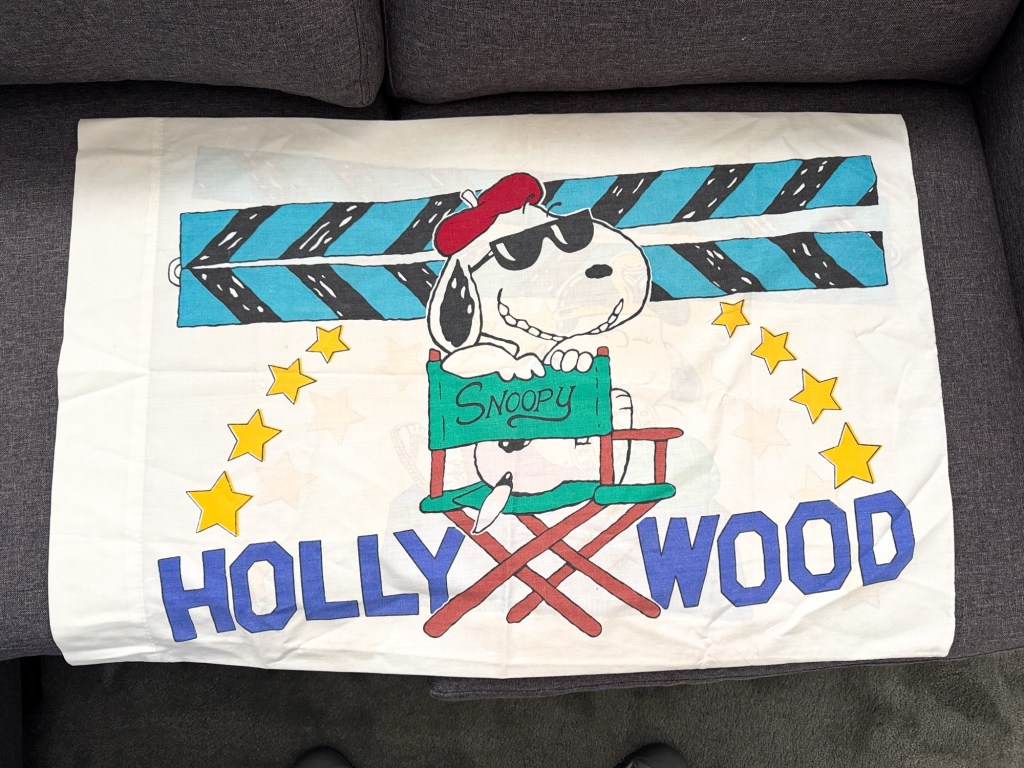
I cannot bring myself to dispose of the last Charlie Brown pillowcase from my university dorm room uover fifty years ago, then passed down to my children, two of whom are in their 40’s. It’s only a pillowcase requiring minimal space.
It now has particular relevance as Bryant works in film and lives in West Hollywood.
With that task complete, we are eagerly anticipating the arrival of one of our former German students, her wife and their daughter and Bryant and his friend, also from Berlin. If anyone else shows up this weekend, you will be relegated to the camping trailer. Could be fun.
I love when the kids return to the nest. This time it was Mari, KC, Bella the grand dog:
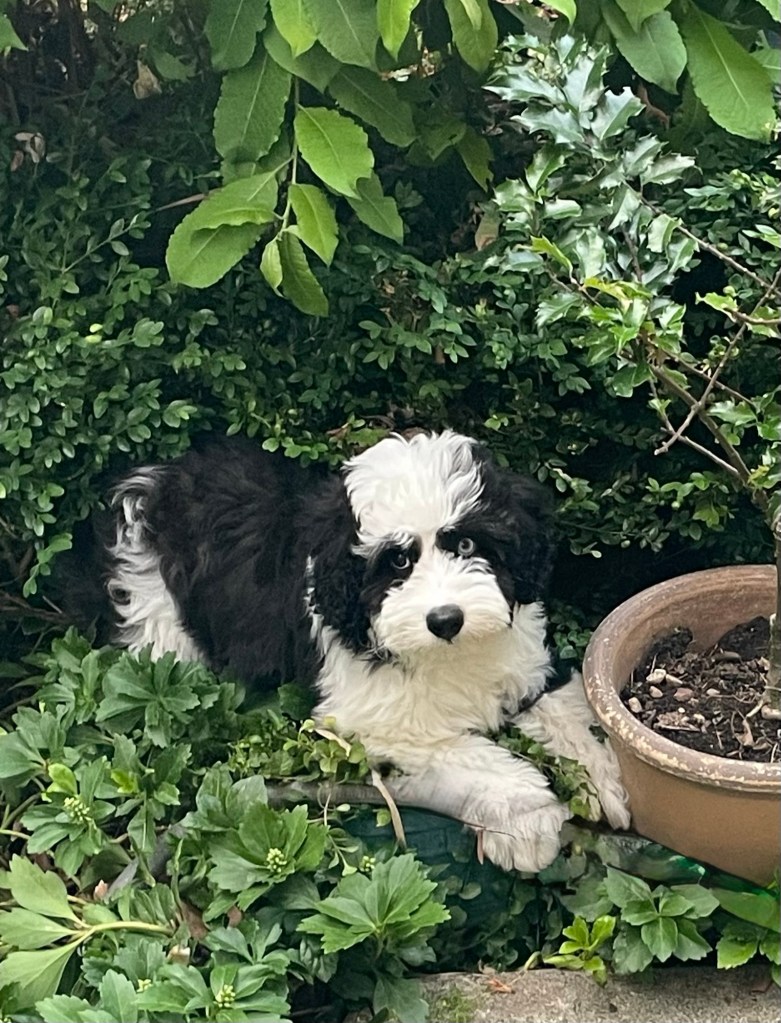
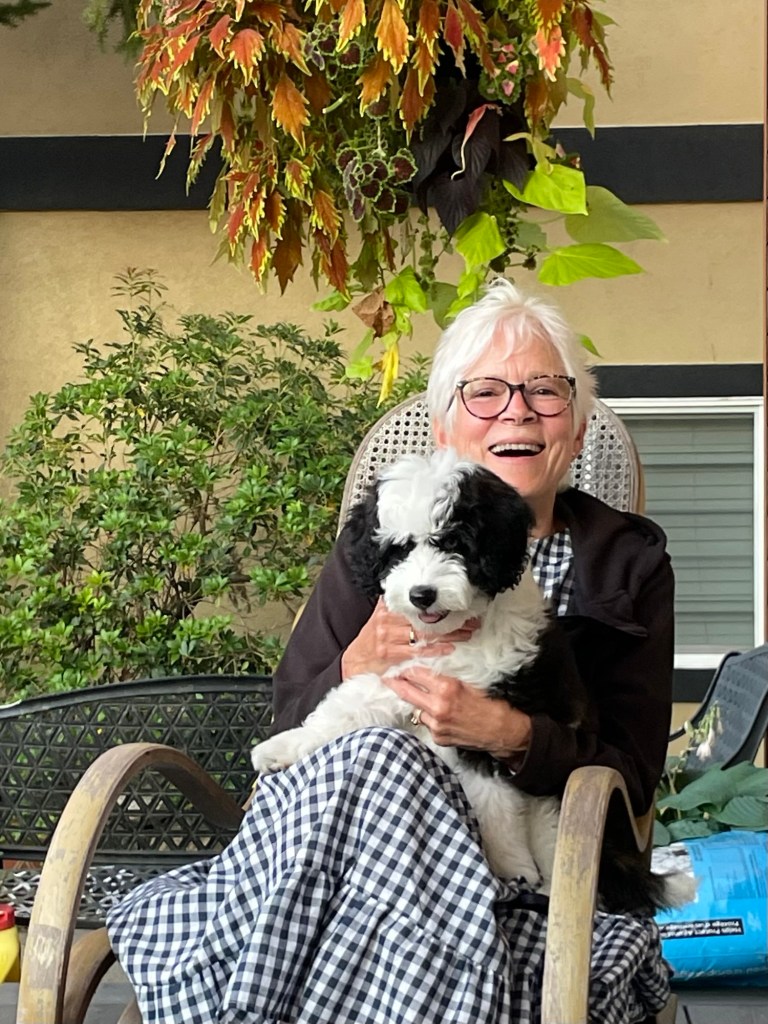
and 12 week old Luigi, technically the great grand dog.
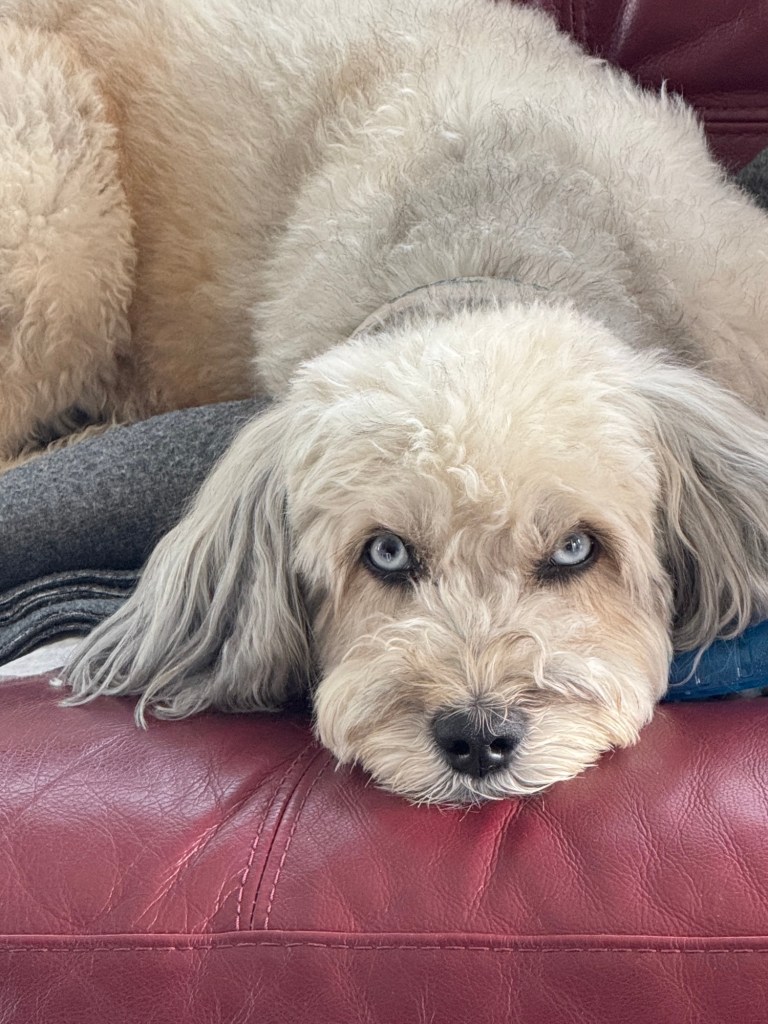
Bella’s recent litter have all gone to their new homes, but M & KC agreed to look after Luigi while his dads were getting engaged in Italy. Is he not one of the cutest pups you’ve ever seen or am I biased?
Bella is an Aussiedoodle and the puppies are Ausdiedoodle/Mini Poodle.
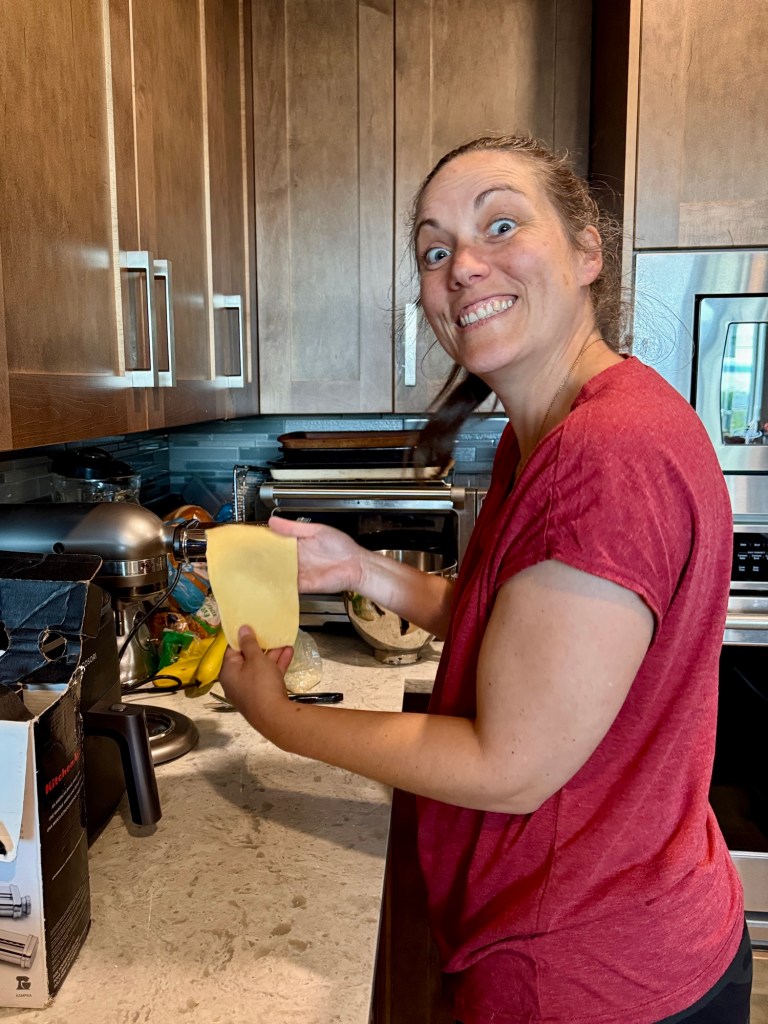
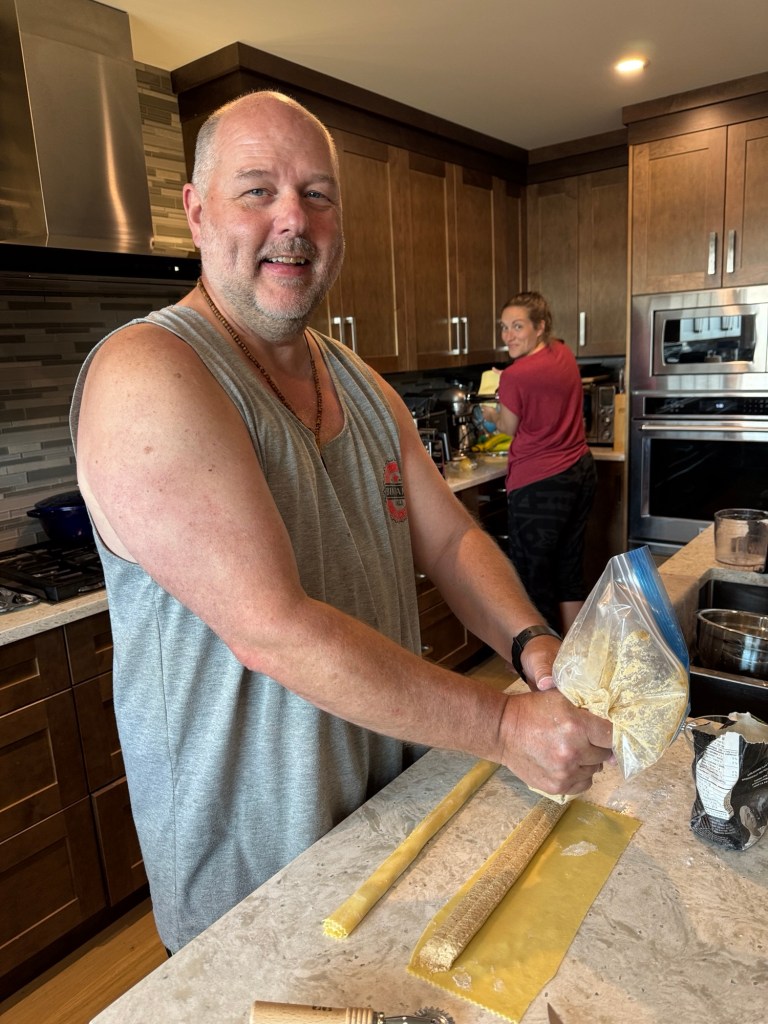
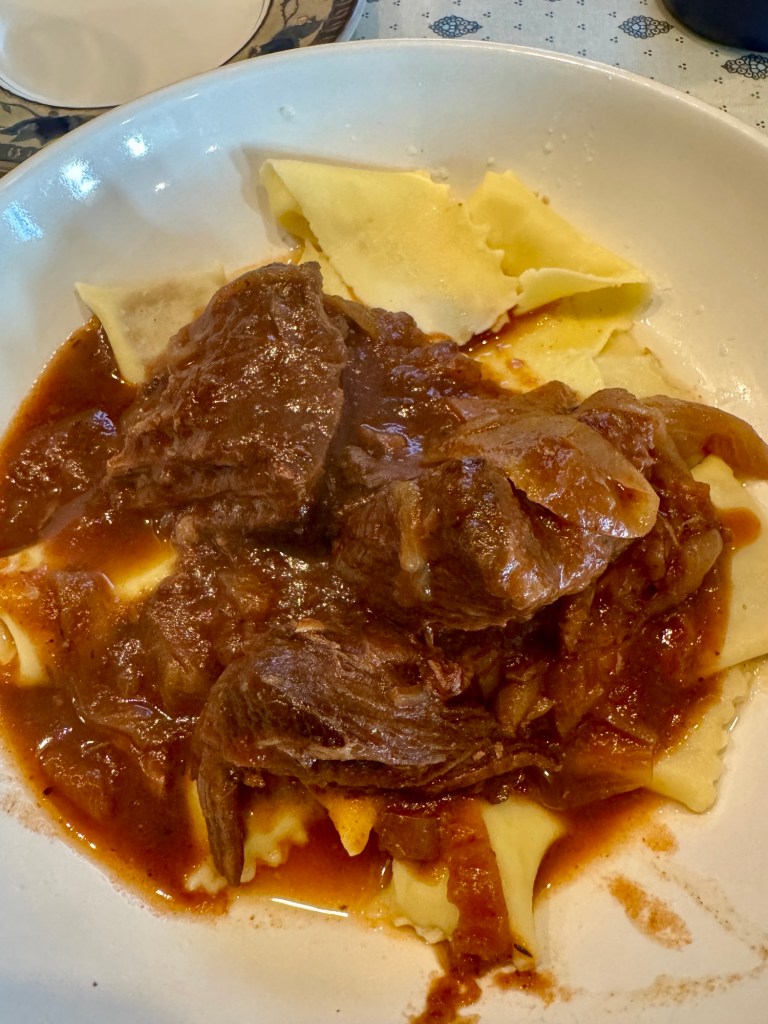
I put the humans to work in the kitchen abiding by KC’s instructions to give him the ingredients and tell him what to cook. This time it was homemade pasta – roasted cauliflower and smoked Gouda agnolotti and pappardelle with smoked short rib ragú I had in the freezer for this occasion.
Mari, my pasta teacher.
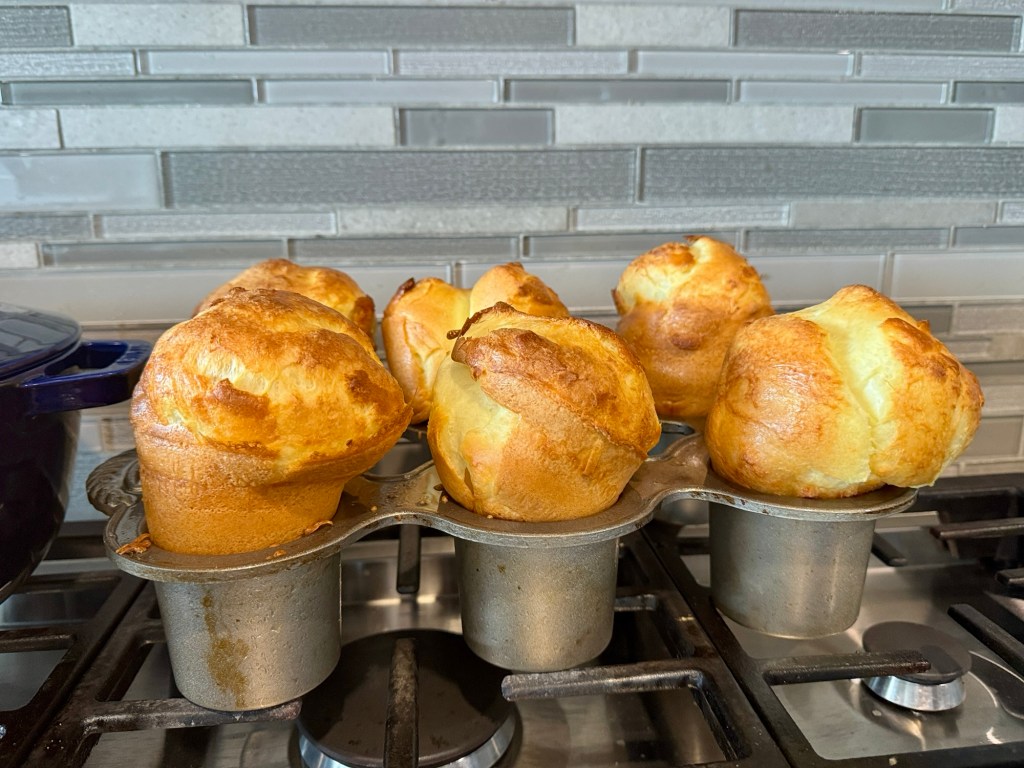
Another meal included Yorkshire Puddings. I was today years old when I finally learned to make non-collapsing yorkies. It’s all about the eggs and the baking temperature.
It was a wonderful week. M and I crossed the border for a run to Trader Joe’s, Walmart and Costco. It was hard to believe that Canadians were still boycotting the US when there was an hour and 50 minute border queue. That will probably change again with today’s tariff announcement.
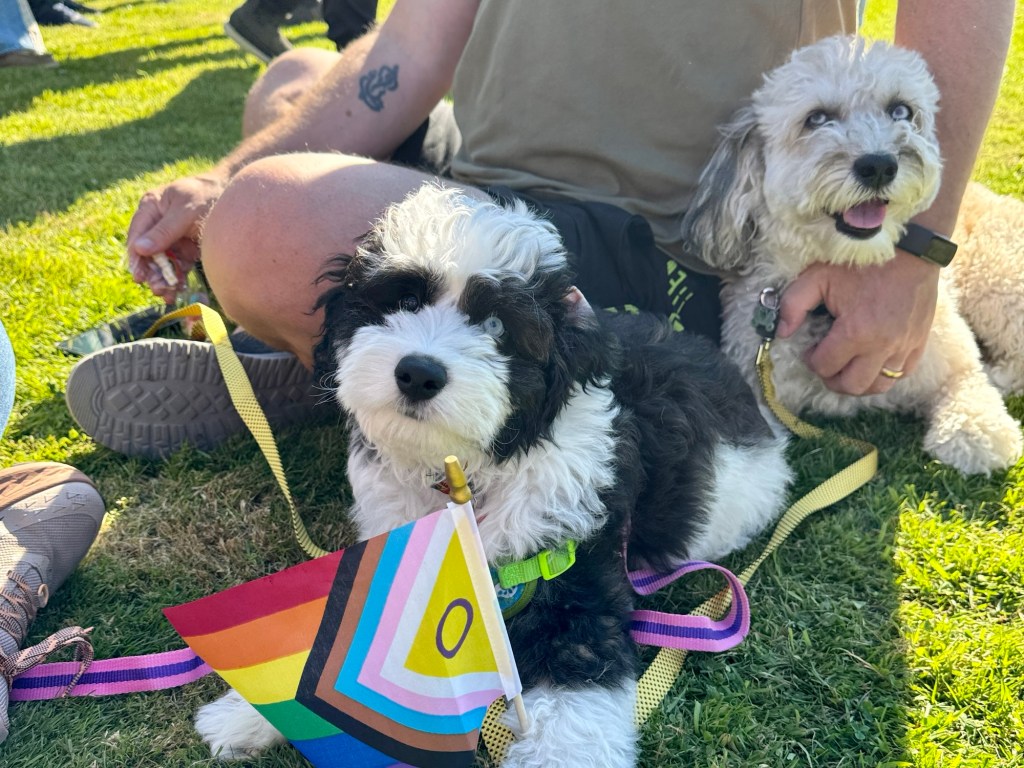
We participated in Pride Week festivities: the flag raising ceremony, the car parade and the family festival.
And we fit in beach time, a five minute walk from our house.
It was a perfect week revolving around food and dogs. We hosted dinner for KC’s former manager on his retirement and went out to celebrate KC’s new position as his replacement.
Today the house is too quiet and I’m counting the weeks until their return.
Driving out of Malakwa we resisted the urge to stop for a third ice cream lunch, but if we did, banana fudge might have been my choice.
Our next gas break was scheduled at Costco in Kamloops. I also wanted to pick up a gift for Rika as she and Mack bailed us out big time at Pinantan when we discovered our camp stove and gas grill had been left behind at home. They happened to have a spare of each in their shed at their seasonal campsite. And who do we run into at Costco? Mack, Rika and their son, David.
Setting up at Logan Lake we were greeted by one of the locals.
In the morning I went hiking up the snowshoe/cross country ski trails. Chuck went fishing. The trails used to be totally forested until wildfires struck a few years back.
It was a strange feeling walking amongst the skeletons of trees.
Evidence of life in a burned out stump, a young Northern Flicker waiting for a feed:
Luckily the fire didn’t jump the road into the campground.
On our last day of the trip, Mack and Rika joined us for the day as they live under an hour from Logan Lake.
I was impressed by Rika’s progress on her initial knitting project:
We took the trail through the woods to the village
and made it back just in time before the skies let loose.
It was close quarters eating lunch under our tiny awning while it poured.
After our goodbyes, C headed back to the dock for a successful round of fishing.
It’s that time of year – more baby birds in the gazebo by the dock:
The final count was six trout bound for the smoker, four caught by Chuck and two donated to the cause by Mack.
The next day was the long ride home, about six hours including a 90 minute rest stop where we both fell asleep on our comfy trailer mattress.
And that’s a wrap for the first camping trip of 2026.